


What's the best version of the Isle of Lewis Chess Set? - ChessBaron Chess Sets Canada
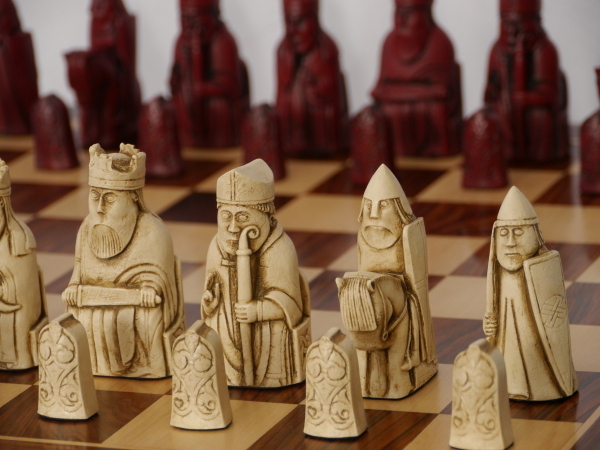
What’s the Best Version of the Isle of Lewis Chess Set?
The famous medieval Lewis chessmen now come in several very different interpretations, from traditional brown and red sets to an aged museum-inspired version and even heavyweight metal.
Few chess sets are instantly recognizable to people who don’t actually play chess. The Isle of Lewis chessmen are an exception. Their anxious kings, stern queens and wonderfully characterful warriors have survived from the medieval world to become perhaps the most famous historic chess pieces of all.
The originals were part of a hoard of 93 pieces discovered at Uig on the Isle of Lewis in 1831 after centuries beneath the sand. Today they are divided between the British Museum and the National Museum of Scotland. For somebody buying a reproduction, however, there is a complication: there isn’t just one Lewis set to choose from.
The Classic Choice: Ivory and Brown
For the most traditional appearance, the Berkeley Ivory and Brown Isle of Lewis set is an obvious starting point. Made in England from crushed marble, the pieces are based on laser scans of the originals. The 3.5-inch king weighs 110g, giving the set considerably more substance than lightweight decorative reproductions.
There is also the heavier Ivory and Brown version. It retains the 3.5-inch king but increases its weight to 145g and uses a slightly narrower 1.65-inch base. For someone who enjoys the classic colouring but prefers a more substantial piece in the hand, this is an interesting step up.
What About the Famous Red Pieces?
Red has a genuine connection with the Lewis story: traces of dark red colouring were found on some pieces in the original hoard. It also creates a stronger visual contrast on the board.
The Ivory and Red Berkeley Lewis set matches the 110g king and 1.75-inch base of the standard brown version, while the heavier Ivory and Red version moves to a 145g king with a 1.65-inch base. In other words, the choice is not simply brown versus red; in either colour scheme there is a lighter or more substantial interpretation.
The Heavyweight: Lewis in Metal
Then there is the version the medieval craftsmen probably weren’t expecting. The Berkeley Metal Isle of Lewis set recreates the familiar forms in steel and copper finishes. Its 3.5-inch king weighs 205g – almost twice the weight of the standard crushed-marble version.
This is less about archaeological atmosphere and more about physical presence. If you like chess pieces to feel extremely substantial, or want a Lewis set that looks striking in a contemporary room, metal offers something none of the other versions can.
For the History Enthusiast: The Deluxe Aged Set
Perhaps the most intriguing alternative is the ChessBaron Deluxe Isle of Lewis set. It draws on pieces held by both the National Museum of Scotland and the British Museum and uses crushed marble with an intentionally aged, rustic appearance.
It also solves a curious Lewis problem. Among the historic pieces is the celebrated berserker rook, shown biting his shield. This set includes both berserker and conventional rook pieces, so they can be changed according to preference. It is a small detail, but precisely the sort of detail that appeals to somebody fascinated by the originals rather than merely their appearance.
So Which Isle of Lewis Set Is Best?
For classic Lewis appearance, choose ivory and brown. For stronger colour and a nod to evidence of historic pigmentation, choose ivory and red. If tactile weight matters, the heavier 145g versions make sense; if sheer solidity is the attraction, the 205g metal king is in another league.
For a history enthusiast, though, the Deluxe aged set has a particularly strong case because of its museum-inspired treatment and choice of berserker or normal rooks. There really isn’t one universally superior Lewis set. The best version depends on whether you value historical atmosphere, colour, weight or contemporary presentation most.
Whichever interpretation wins, those unmistakable medieval faces remain the stars. More than eight centuries after they were carved, they still manage to make an ordinary chess position look as though something rather serious is happening.